Showing posts with label CS Lewis. Show all posts

Thursday, May 2, 2013

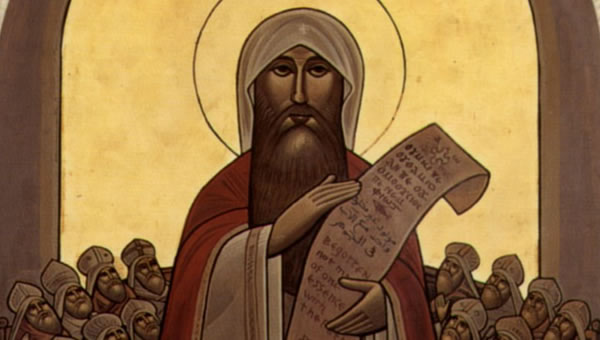
St Athanasius - Feast day is May 2

Saint Athanasius
His epitaph is Athanasius contra mundum, “Athanasius against the world.” We are proud that our own country has more than once stood against the world. Athanasius did the same. He stood for the Trinitarian doctrine, “whole and undefiled,” when it looked as if all the civilised world was slipping back from Christianity into the religion of Arius—into one of those “sensible” synthetic religions which are so strongly recommended today and which, then as now, included among their devotees many highly cultivated clergymen. It is his glory that he did not move with the times; it is his reward that he now remains when those times, as all times do, have moved away. - CS Lewis
Saint Athanasius of Alexandria
From Pope Benedict XVI, General Audience

Dear Brothers and Sisters,

Continuing our re-visitation of the great Teachers of the ancient Church, let us focus our attention today on St Athanasius of Alexandria.

Only a few years after his death, this authentic protagonist of the Christian tradition was already hailed as "the pillar of the Church" by Gregory of Nazianzus, the great theologian and Bishop of Constantinople (Orationes, 21, 26), and he has always been considered a model of orthodoxy in both East and West.

Athanasius was undoubtedly one of the most important and revered early Church Fathers... (f)or Athanasius was also the most important and tenacious adversary of the Arian heresy, which at that time threatened faith in Christ, reduced to a creature "halfway" between God and man, according to a recurring tendency in history which we also see manifested today in various forms.

In all likelihood Athanasius was born in Alexandria, Egypt, in about the year 300 A.D. He received a good education before becoming a deacon and secretary to the Bishop of Alexandria, the great Egyptian metropolis. As a close collaborator of his Bishop, the young cleric took part with him in the Council of Nicaea, the first Ecumenical Council, convoked by the Emperor Constantine in May 325 A.D. to ensure Church unity. The Nicene Fathers were thus able to address various issues and primarily the serious problem that had arisen a few years earlier from the preaching of the Alexandrian priest, Arius.

With his theory, Arius threatened authentic faith in Christ, declaring that the Logos was not a true God but a created God, a creature "halfway" between God and man who hence remained for ever inaccessible to us. The Bishops gathered in Nicaea responded by developing and establishing the "Symbol of faith" ["Creed"] which, completed later at the First Council of Constantinople, has endured in the traditions of various Christian denominations and in the liturgy as the Niceno-Constantinopolitan Creed.

In this fundamental text - which expresses the faith of the undivided Church and which we also recite today, every Sunday, in the Eucharistic celebration - the Greek term homooúsiosis featured, in Latin consubstantialis: it means that the Son, the Logos, is "of the same substance" as the Father, he is God of God, he is his substance. Thus, the full divinity of the Son, which was denied by the Arians, was brought into the limelight.

In 328 A.D., when Bishop Alexander died, Athanasius succeeded him as Bishop of Alexandria. He showed straightaway that he was determined to reject any compromise with regard to the Arian theories condemned by the Council of Nicaea...

Despite the unequivocal outcome of the Council, which clearly affirmed that the Son is of the same substance as the Father, these erroneous ideas shortly thereafter once again began to prevail - in this situation even Arius was rehabilitated -, and they were upheld for political reasons by the Emperor Constantine himself and then by his son Constantius II.

Moreover, Constantine was not so much concerned with theological truth but rather with the unity of the Empire and its political problems; he wished to politicize the faith, making it more accessible - in his opinion - to all his subjects throughout the Empire.

Thus, the Arian crisis, believed to have been resolved at Nicaea, persisted for decades with complicated events and painful divisions in the Church. At least five times - during the 30 years between 336 and 366 A.D. - Athanasius was obliged to abandon his city, spending 17 years in exile and suffering for the faith. But during his forced absences from Alexandria, the Bishop was able to sustain and to spread in the West, first at Trier and then in Rome, the Nicene faith as well as the ideals of monasticism, embraced in Egypt by the great hermit, Anthony, with a choice of life to which Athanasius was always close.

St Anthony, with his spiritual strength, was the most important champion of St Athanasius' faith. Reinstated in his See once and for all, the Bishop of Alexandria was able to devote himself to religious pacification and the reorganization of the Christian communities. He died on 2 May 373, the day when we celebrate his liturgical Memorial.

The most famous doctrinal work of the holy Alexandrian Bishop is his treatise: De Incarnatione, On the Incarnation of the Word, the divine Logos who was made flesh, becoming like one of us for our salvation.
In this work Athanasius says with an affirmation that has rightly become famous that the Word of God "was made man so that we might be made God; and he manifested himself through a body so that we might receive the idea of the unseen Father; and he endured the insolence of men that we might inherit immortality" (54, 3). With his Resurrection, in fact, the Lord banished death from us like "straw from the fire" (8, 4).

The fundamental idea of Athanasius' entire theological battle was precisely that God is accessible. He is not a secondary God, he is the true God and it is through our communion with Christ that we can truly be united to God. He has really become "God-with-us"...

Lastly, Athanasius also wrote meditational texts on the Psalms, subsequently circulated widely, and in particular, a work that constitutes the bestseller of early Christian literature: The Life of Anthony, that is, the biography of St Anthony Abbot. It was written shortly after this Saint's death precisely while the exiled Bishop of Alexandria was staying with monks in the Egyptian desert. 

Athanasius was such a close friend of the great hermit that he received one of the two sheepskins which Anthony left as his legacy, together with the mantle that the Bishop of Alexandria himself had given to him.
The exemplary biography of this figure dear to Christian tradition soon became very popular, almost immediately translated into Latin, in two editions, and then into various Oriental languages; it made an important contribution to the spread of monasticism in the East and in the West...

Moreover, Athanasius himself showed he was clearly aware of the influence that Anthony's fine example could have on Christian people. Indeed, he wrote at the end of this work: 
"The fact that his fame has been blazoned everywhere, that all regard him with wonder, and that those who have never seen him long for him, is clear proof of his virtue and God's love of his soul. For not from writings, nor from worldly wisdom, nor through any art, was Anthony renowned, but solely from his piety towards God. That this was the gift of God no one will deny.
"For from whence into Spain and into Gaul, how into Rome and Africa, was the man heard of who dwelt hidden in a mountain, unless it was God who makes his own known everywhere, who also promised this to Anthony at the beginning? For even if they work secretly, even if they wish to remain in obscurity, yet the Lord shows them as lamps to lighten all, that those who hear may thus know that the precepts of God are able to make men prosper and thus be zealous in the path of virtue" (Life of Anthony, 93, 5-6).
Yes, brothers and sisters! We have many causes for which to be grateful to St Athanasius. His life, like that of Anthony and of countless other saints, shows us that "those who draw near to God do not withdraw from men, but rather become truly close to them" (Deus Caritas Est, n. 42).

Saturday, November 26, 2011

You Must Make Your Choice

C.S. Lewis from Mere Christianity

"I am trying here to prevent anyone saying the really foolish thing that people often say about Him: I’m ready to accept Jesus as a great moral teacher, but I don’t accept his claim to be God. That is the one thing we must not say. A man who was merely a man and said the sort of things Jesus said would not be a great moral teacher. He would either be a lunatic — on the level with the man who says he is a poached egg — or else he would be the Devil of Hell. You must make your choice. Either this man was, and is, the Son of God, or else a madman or something worse. You can shut him up for a fool, you can spit at him and kill him as a demon or you can fall at his feet and call him Lord and God, but let us not come with any patronising nonsense about his being a great human teacher. He has not left that open to us. He did not intend to. ... Now it seems to me obvious that He was neither a lunatic nor a fiend: and consequently, however strange or terrifying or unlikely it may seem, I have to accept the view that He was and is God."

Friday, November 12, 2010

A Dragon's Tale


I was recollecting this story by Marjorie Thompson today and I discovered that the movie of CS Lewis' book, The Voyage of the Dawn Treader will be coming out next month.  Awesome.  Before you get swept away by the movie check out this little piece called, A Dragon's Tale.  And below I have a link to a great Radio Theatre Drama of this very segment of the book.

A Dragon’s Tale*
by Marjorie Thompson

There was a boy called Eustace Clarence Scrubb, and he almost deserved it. His parents called him Eustace Clarence, and his schoolmasters called him Scrubb. I can’t tell you how his friends spoke to him, for he had none… Eustace Clarence liked animals, especially beetles, if they were dead and pinned on a card…. Deep down he liked bossing and bullying; and though he was a puny little person who couldn’t have stood… in a fight, he knew that there are dozens of ways to give people a bad time…
So begins The Voyage of the Dawn Treader, the third Narnian Chronicle by C. S. Lewis. What follows is a story from that world – a story of lions and dragons, a story of transformation.

To begin with, Eustace Scrubb had no imagination and no patience with his cousins who did. He taunted and pestered them because they childishly believed in a land called Narnia, ruled by a lion named Aslan, whom no one in the world but the four of them had ever seen. Scrubb prided himself on being unsentimental, scientific, and cultured; others might have described him as rude, boring, and haughty. Having been raised on Plumptree’s Vitaminized Nerve Food, Scrubb’s tastes were, in fact, deplorably narrow. It took little to turn his delicate stomach and sheltered eyes. To be quite bald, Eustace was the world’s original “wimp.”

Imagine, then, the poor lad’s dismay when the “fictitious” land of Narnia suddenly became a living reality, and Scrubb found himself affected by the very Magic he had ridiculed with such disdain! I am sorry to report that when this took place, the boy’s already ungracious character became absolutely unbearable. He made out his cousins, and everyone else in Narnia, to be ogres; he refused to take responsibility for anything in the course of their adventures; he insisted on viewing himself as the only sane individual; and he expected exceptions to be made on his account alone – assuming that he always got the short end of the stick, no matter how civil, even generous, the others were to him. So there you have Eustace Clarence Scrubb, for better or worse – and mostly, I’m afraid, for worse.

As the story progresses, the adventurers’ ship survives a devastating storm and finds harbor on an unknown island. Eustace, unaccustomed to work, creeps off to take his ease while the others set to repairs. He manages to get thoroughly lost and ends up in the valley of a dragon! Now the dragon itself is scarcely a cause for alarm; Eustace comes upon the elderly creature just in time to watch it expire. Then the real adventure begins. A blinding rain drives Scrubb into the dragon’s cave; and there, as his eyes grow accustomed to the dark, Eustace realizes that the sharp objects he is sitting on are not rocks. They are crowns and rings and heavy necklaces – all gold and precious jewels!

Of course, you and I would know right away that a dragon’s cave is filled with treasure; but Eustace had never read the sort of books that tell you these things. Gazing at the sheer magnitude of riches, his eyes grew large and his hands grew itchy and his heart filled with desire. “They don’t have any taxes here,” he astutely observed. But he had no sooner slipped a heavy gold bracelet over his arm when fatigue overtook him. He fell asleep on the treasure heap, and when he awoke, he discovered to his utter horror that he himself had turned into a dragon! Lewis writes, “Sleeping on a dragon’s hoard, with greedy, dragonish thought in his heart, he had become a dragon himself.”

Time out. Is sin a word you have trouble identifying with? I suppose most of us don’t really like to call ourselves “miserable sinners,” or sing and mean “a wretch like me.” I once knew a woman who told me, “I hate the prayer of confession in our worship service; I can never identify with all those awful things we say about ourselves. I’m not like that; I live a good life.”

Perhaps many of us feel this way. One thing seems clear to me: that sin results in a certain blindness to the truth of our condition – the condition of being alienated from God, from one another, and from our deeper self. Sin is not simply a matter of the wroungheadedness of particular thoughts or deeds. Sin is a deeper orientation of life from which all of us suffer. If we have trouble recognizing our basic brokenness, might it be that this difficulty itself is a sign of our disease?

Eustace saw himself as an intelligent and superior sort of person; others could see his tragic flaws more clearly. In effect, Eustace’s character was beastly all along, but he couldn’t recognize it until it got so inflated that it took visible form. Then he could see his beastliness reflected back to him.

What prevents us from seeing our tragic flaws? Certainly we want to be perceived as good, as right, as intelligent, as attractive. We often feel as if we should be all these things at all times; so, whether we think we are or not, we expend a great deal of energy trying to prove to others and to ourselves that we are. These very human patterns have other names: pride, envy, anxiety, defensiveness, rationalization, and self-justification, to name just a few. Each has a way of blinding us to our real predicament. We all indulge in such protective illusions at one time or other, individually and as communities – even nations. Fortunately, there are mirrors around. Sometimes we catch our reflection and, for a moment, see ourselves as others see us.

When Eustace realizes that he has actually become a monster cut off from the human race, he begins to look back on his life with different eyes: “An appalling loneliness came over him. He began to see that the others had not really been fiends at all. He began to wonder if he himself had ever been such a nice person as he had always supposed. He longed for their voices.”

When we recognize our inner distortions and see how they have cut us off from real relationships, we too discover a deep longing for human community. We often want to refashion our behavior to fit our changed perception and attitude. But at this point, most of us will find that the desire to change and the capacity to change are not evenly matched.

Paul speaks with hard-hitting honesty in Romans 7: “though the will to do good is there, the deed is not. The good which I want to do, I fail to do; but what I do is the wrong which is against my will… it is no longer I who am agent, but sin that has its lodging in me…”

I know what the old apostle is talking about. One of my weaknesses is procrastination. Suppose I have a major task ahead, and I promise myself I will start working on it early, both for quality and sanity’s sake. As the time approaches, I invariably find myself placing far less urgent tasks before the critical one – checking the mail, watering the plants, clearing off the desk. Any little excuse will suffice. I am aware of indulging my avoidance but can hardly resist the urge to put off the real work until pressure reaches a critical peak of discomfort.

Your “Achilles’ heel” may be different: perhaps overindulgence in food or TV; perhaps a habit of being sarcastic or critical despite a hundred self-administered lectures on biting your tongue. Each of us has at least a few areas where “willpower” just doesn’t carry enough voltage, no matter how we try to convince our actions to fall in line.

“Miserable creature that I am, who will rescue me from this body doomed to death?” Paul’s anguished cry is born of just such human experience. But Paul has an answer for his own existential question. It is the same answer discovered by our young friend, Eustace – turned – dragon, who now wants nothing so desperately as to become himself again. Not only is he odious to himself; he is a burden to his Narnian friends who must take him with them on their continued voyage – and however will he fit into the ship?

At this critical point – when the desire to change is real, but the capacity is not – Eustace meets Aslan, the great lion, “Son of the Emperor over Sea,” who saved Narnia back in the days of the White Witch. Eustace does not know who Aslan is, but senses his authority, fears him dreadfully, and obeys without hesitation when the lion bids him follow.

Aslan leads Eustace a long way to a mountaintop garden, in whose center lies a wide well of pure, clear water. Eustace longs to bathe in it, but the lion first commands him to undress. Our dragon friend succeeds in tearing off his outer skin and scales, rather like a banana peel. But when he approaches the water, his reflection still reveals a dragon skin. Twice more he scratches off his rough and wrinkled suit, and twice again finds himself yet encased in the vestment of a beast.

Then Aslan speaks: “You will have to let me undress you.” Eustace later recalled the experience in these words:
          The very first tear he made was so deep that I thought it had gone right to my heart. And when he began pulling the skin off, it hurt worse than anything I’ve ever felt. The only thing that made me able to bear it was just the pleasure of feeling the stuff come off.
          … Well, he peeled it right off – just as I thought I’d done it myself the other three times, only they hadn’t hurt – and there it was, lying on the grass, only ever so much thicker, and darker, and more knobby looking than the others had been. And there I was as smooth and soft as a peeled switch. Then he caught hold of me – I was very tender underneath now that I’d no skin on – and he threw me into the water. It smarted like anything, but only for a moment. After that it became perfectly delicious and … I found that all the pain had gone. And then I saw why. I’d been turned into a boy again… After a bit, the lion took me out and dressed me.
Eustace Clarence Scrubb will tell you from experience that you cannot achieve your own inner transformation. We can neither take off the old skin of sin, nor re-dress ourselves in righteousness. That is why, in the words of one of our familiar hymns, we ask God to “re-clothe us in our rightful mind.” Our desire to change is a necessary preparation for the painful but wonderful process of being changed by God’s grace. When Christ strips us of our dragonish self, he goes much deeper than we do – right to the heart. Real change means giving up much of what we assume is natural to us. That’s why we cannot do it ourselves; we simply do not see how radical the surgery needs to be, and even if we did, we would be powerless to perform it. Yet the pain of this radical transformation quickly becomes joy as we see and feel genuine health emerging underneath.

Eustace found that he was a boy again, although a boy with a much improved character. His old self was fast withering away; a new person, his true self, was now free to emerge. But if his encounter with Aslan marked a fundamental change of heart, it did not yet mean that Eustace was perfect. The end of his story is an apt reminder to each of us of the ongoing character of transformation:
It would be nice, and fairly nearly true, to say that “from that time on Eustace was a different boy.” To be strictly accurate, he began to be a different boy. He had relapses. There were still many days when he could be quite tiresome. But … the cure had begun.
It takes time for our new self in Christ to be fully realized. But if you have ever tried to change yourself and been disappointed; and if you have then given yourself over to the One whose love alone can transform us; and if you have seen even some part of your life turned around through the mystery of this encounter, then you, too, can be sure that the cure has begun. Thanks be to God, who gives us the victory!

Prayer: Lord, thank you for loving us even when we are beastly; for your patience when we are tiresome and blind; for your stern yet tender love which longs to heal us from this painful disease called sin. Help us to see our need; to desire your touch; and to receive your transforming love, offered to us through Christ our Lord. We pray in his name. Amen.

* Article appeared in the March/April 1991 Weavings publication

Here is short clip that captures Eustace and this dragon-self from The Chronicles of Narnia: The Voyage of the Dawn Treader.

Eustace |To The Stars| Dragon Heart