Showing posts with label Pope Benedict XVI. Show all posts

Friday, June 12, 2020

The Real Presence Requires the Sacrament and the Church

ENCOUNTERING CHRIST IN THE EUCHARIST

We need the living Christ, whom we can know only through our encounter with him. But encounter presumes actual presence—the Real Presence, which, in turn, requires the Sacrament and the Church that alone is authorized to give us the Sacrament, the Church that Christ himself willed into existence and continues to support. The Eucharist, at each new celebration, must be recognized anew as the core of our Christian life. But we cannot celebrate the Eucharist adequately if we are content to reduce it to a ritual of—more or less—a half-hour’s duration. To receive Christ means to worship him. We welcome him properly and worthily at the solemn moment of receiving him only when we worship him and in worshiping him learn to know him, come to understand his nature, and follow him. We need to learn once more how to rest peacefully in his gentle presence in our churches, where the Eucharist is likewise always present because Christ intercedes for us before the Father, because he always awaits us and speaks to us. We must learn again how to draw inwardly close to him, for it is only thus that we become worthy of the Eucharist. We cannot prepare ourselves to receive the Eucharist simply by thinking about how it should be done. We can prepare for it only when we try to comprehend the depths of its demands on us, of its greatness; when we do not reduce it to our level, but let ourselves be raised to its exalted level; when we become aware of the accumulated sound of the prayers offered during all the centuries in which generations of men have advanced and are still advancing toward Christ. It is petty and undiscerning to criticize such prayers because we do not understand them; it is an expression of a genuinely “critical” sentiment (of which, be it noted, self-criticism is also a form) when we begin to recognize their greatness and, opening ourselves to that greatness, let ourselves be deepened and purified by it.
From: Joseph Ratzinger, Roman homilies, October 12, 1982

Thursday, May 2, 2013

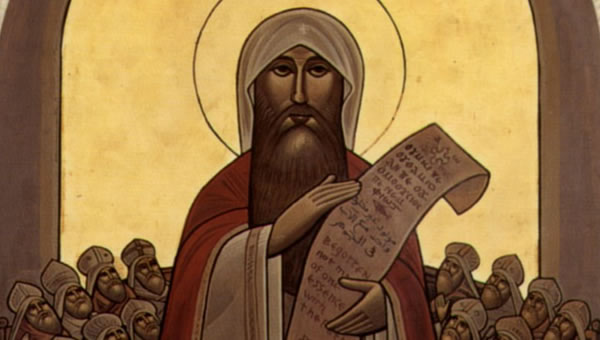
St Athanasius - Feast day is May 2

Saint Athanasius
His epitaph is Athanasius contra mundum, “Athanasius against the world.” We are proud that our own country has more than once stood against the world. Athanasius did the same. He stood for the Trinitarian doctrine, “whole and undefiled,” when it looked as if all the civilised world was slipping back from Christianity into the religion of Arius—into one of those “sensible” synthetic religions which are so strongly recommended today and which, then as now, included among their devotees many highly cultivated clergymen. It is his glory that he did not move with the times; it is his reward that he now remains when those times, as all times do, have moved away. - CS Lewis
Saint Athanasius of Alexandria
From Pope Benedict XVI, General Audience

Dear Brothers and Sisters,

Continuing our re-visitation of the great Teachers of the ancient Church, let us focus our attention today on St Athanasius of Alexandria.

Only a few years after his death, this authentic protagonist of the Christian tradition was already hailed as "the pillar of the Church" by Gregory of Nazianzus, the great theologian and Bishop of Constantinople (Orationes, 21, 26), and he has always been considered a model of orthodoxy in both East and West.

Athanasius was undoubtedly one of the most important and revered early Church Fathers... (f)or Athanasius was also the most important and tenacious adversary of the Arian heresy, which at that time threatened faith in Christ, reduced to a creature "halfway" between God and man, according to a recurring tendency in history which we also see manifested today in various forms.

In all likelihood Athanasius was born in Alexandria, Egypt, in about the year 300 A.D. He received a good education before becoming a deacon and secretary to the Bishop of Alexandria, the great Egyptian metropolis. As a close collaborator of his Bishop, the young cleric took part with him in the Council of Nicaea, the first Ecumenical Council, convoked by the Emperor Constantine in May 325 A.D. to ensure Church unity. The Nicene Fathers were thus able to address various issues and primarily the serious problem that had arisen a few years earlier from the preaching of the Alexandrian priest, Arius.

With his theory, Arius threatened authentic faith in Christ, declaring that the Logos was not a true God but a created God, a creature "halfway" between God and man who hence remained for ever inaccessible to us. The Bishops gathered in Nicaea responded by developing and establishing the "Symbol of faith" ["Creed"] which, completed later at the First Council of Constantinople, has endured in the traditions of various Christian denominations and in the liturgy as the Niceno-Constantinopolitan Creed.

In this fundamental text - which expresses the faith of the undivided Church and which we also recite today, every Sunday, in the Eucharistic celebration - the Greek term homooúsiosis featured, in Latin consubstantialis: it means that the Son, the Logos, is "of the same substance" as the Father, he is God of God, he is his substance. Thus, the full divinity of the Son, which was denied by the Arians, was brought into the limelight.

In 328 A.D., when Bishop Alexander died, Athanasius succeeded him as Bishop of Alexandria. He showed straightaway that he was determined to reject any compromise with regard to the Arian theories condemned by the Council of Nicaea...

Despite the unequivocal outcome of the Council, which clearly affirmed that the Son is of the same substance as the Father, these erroneous ideas shortly thereafter once again began to prevail - in this situation even Arius was rehabilitated -, and they were upheld for political reasons by the Emperor Constantine himself and then by his son Constantius II.

Moreover, Constantine was not so much concerned with theological truth but rather with the unity of the Empire and its political problems; he wished to politicize the faith, making it more accessible - in his opinion - to all his subjects throughout the Empire.

Thus, the Arian crisis, believed to have been resolved at Nicaea, persisted for decades with complicated events and painful divisions in the Church. At least five times - during the 30 years between 336 and 366 A.D. - Athanasius was obliged to abandon his city, spending 17 years in exile and suffering for the faith. But during his forced absences from Alexandria, the Bishop was able to sustain and to spread in the West, first at Trier and then in Rome, the Nicene faith as well as the ideals of monasticism, embraced in Egypt by the great hermit, Anthony, with a choice of life to which Athanasius was always close.

St Anthony, with his spiritual strength, was the most important champion of St Athanasius' faith. Reinstated in his See once and for all, the Bishop of Alexandria was able to devote himself to religious pacification and the reorganization of the Christian communities. He died on 2 May 373, the day when we celebrate his liturgical Memorial.

The most famous doctrinal work of the holy Alexandrian Bishop is his treatise: De Incarnatione, On the Incarnation of the Word, the divine Logos who was made flesh, becoming like one of us for our salvation.
In this work Athanasius says with an affirmation that has rightly become famous that the Word of God "was made man so that we might be made God; and he manifested himself through a body so that we might receive the idea of the unseen Father; and he endured the insolence of men that we might inherit immortality" (54, 3). With his Resurrection, in fact, the Lord banished death from us like "straw from the fire" (8, 4).

The fundamental idea of Athanasius' entire theological battle was precisely that God is accessible. He is not a secondary God, he is the true God and it is through our communion with Christ that we can truly be united to God. He has really become "God-with-us"...

Lastly, Athanasius also wrote meditational texts on the Psalms, subsequently circulated widely, and in particular, a work that constitutes the bestseller of early Christian literature: The Life of Anthony, that is, the biography of St Anthony Abbot. It was written shortly after this Saint's death precisely while the exiled Bishop of Alexandria was staying with monks in the Egyptian desert. 

Athanasius was such a close friend of the great hermit that he received one of the two sheepskins which Anthony left as his legacy, together with the mantle that the Bishop of Alexandria himself had given to him.
The exemplary biography of this figure dear to Christian tradition soon became very popular, almost immediately translated into Latin, in two editions, and then into various Oriental languages; it made an important contribution to the spread of monasticism in the East and in the West...

Moreover, Athanasius himself showed he was clearly aware of the influence that Anthony's fine example could have on Christian people. Indeed, he wrote at the end of this work: 
"The fact that his fame has been blazoned everywhere, that all regard him with wonder, and that those who have never seen him long for him, is clear proof of his virtue and God's love of his soul. For not from writings, nor from worldly wisdom, nor through any art, was Anthony renowned, but solely from his piety towards God. That this was the gift of God no one will deny.
"For from whence into Spain and into Gaul, how into Rome and Africa, was the man heard of who dwelt hidden in a mountain, unless it was God who makes his own known everywhere, who also promised this to Anthony at the beginning? For even if they work secretly, even if they wish to remain in obscurity, yet the Lord shows them as lamps to lighten all, that those who hear may thus know that the precepts of God are able to make men prosper and thus be zealous in the path of virtue" (Life of Anthony, 93, 5-6).
Yes, brothers and sisters! We have many causes for which to be grateful to St Athanasius. His life, like that of Anthony and of countless other saints, shows us that "those who draw near to God do not withdraw from men, but rather become truly close to them" (Deus Caritas Est, n. 42).

Sunday, April 7, 2013

Art of Praying

from The Art of Praying
Fr. Romano Guardini  
The basic meaning of the word recollected is "to be unified, gathered together." A glance at our life will show how much we lack this aptitude. We should have a fixed center which, like the hub of a wheel, governs our movements and from which all our actions go out and to which they return; a standard also, or a code by which we distinguish the important from the unimportant, the end from the means, and which puts actions and experience into their proper order; something stable, unaffected by change and yet capable of development, which makes it clear to us who we are and how matters stand with us. We lack this; we, the men of today lack it more than did those who lived in earlier ages. 
This becomes evident in our attempts to pray. Spiritual teachers speak of distractions that state in which man lacks poise and unity, that state in which thoughts flit from object to object, in which feelings are vague and unfocused and the will ineffective. Man in this state is not really a person who speaks or who can be spoken to, but merely an uncoordinated bundle of thoughts, feelings, and sensations. Recollectedness means that he who prays gathers himself together, directs his attention to what he is doing, draws in all thought--a painstaking task--so as to dedicate himself to prayer as a unified whole. This is the state in which he may, when the call comes to him, answer in the words of Moses, "Here I am."
The distractions in prayer come from the disjointedness of life. Some may claim that there seem to be more distractions today because there is a greater amount of information flowing in constantly. We cannot be focused on any issue for more than a few minutes at a time IF we allow ourselves to react to all of that information. And who can argue this claim. However the symptom of this carving-to-overdose on any and everything is our sense of emptiness -  a lack of ontological density. From my mentor Gil Bailie:
Lack of ontological density means a self that is insubstantial and it is seeking in self-defeating ways some way of substantiating itself. There are 2 ways of substantiating the self: 1) that way that perfectly parallels the cultural system that generates false transcendence; and 2) the experience of true transcendence.
However one understands the breakdown in the sense of being centered, of having a focus for one's life, the remedy abides somewhere in the mystery knowing that there is something greater here - in the very mystery of faith. Faith is a gathering up of all the me's into something larger than a self.
“Faith is the finding of a ‘You’ that upholds me and, amid all the unfulfilled…hope of human encounters, gives me the promise of an indestructible love that not only longs for eternity but also guarantees it. Christian faith lives on the discovery that not only is there such a thing as objective meaning but that this meaning knows me and loves me, that I can entrust myself to it like [a] child.” Pope Benedict XVI
To truly practice the Art of Praying in today's fast-paced, distracted and scandalized culture we may want to allow less of the world to intrude into our thoughts and instead hone in on and become participants in all things of beauty, truth and goodness.  

Saturday, March 23, 2013

Truth that will set us free?


Paul VI Audience Hall
Thursday, 23 February 2012

God’s oneness is identified with our hope. Why? In what way? Because God’s oneness is hope, because this guarantees us that, in the end, there are no different powers, in the end there is no dualism between different and clashing powers, in the end there is no dragon’s head left which could be raised against God, the filth of evil and sin is no more.
In the end all that is left is light! God is the one and only God: there is no other power against him! We know that today, with the ever increasing evils we experience in the world, many doubt in God’s Almightiness; indeed, various theologians — even good ones — say that God cannot be Almighty because what we see in the world is incompatible with almightiness. And in this way they wish to create a new apology, to excuse God and to “exculpate” God from these evils.
However this is not the right way, because if God is not Almighty, if other powers exist and endure he is not truly God and is not truly hope, because in the end there would be polytheism, in the end there would be fighting, the power of evil. God is Almighty, the one God. Of course, in history a limit has been set on his omnipotence, recognizing our freedom. However, in the end everything returns and no other power is left; this is the hope: that the light wins, that love wins! In the end the power of evil does not endure, only God endures! And thus we journey on in hope, walking towards the oneness of the one God, revealed to us by the Holy Spirit in the One Lord, Christ. 

...

Truth is not imposed with other means than itself! Truth can only come through itself, through its own light. However, we stand in need of truth; without truth we do not know the true values and how could we order the kosmos of values? Without truth we are blind in the world, we have no path. The great gift of Christ is precisely that we see the Face of God and, even though we see it enigmatically, very insufficiently, we know its basis, the essential of truth in Christ, in his Body. And in knowing this truth, we also grow in charity, which is the legitimation of the truth and shows us that it is truth.
I would say precisely that charity is the fruit of truth — the tree is known by its fruit — and if there is no charity, then truth is not adopted or lived either; and where truth is, charity comes into being. 

Thursday, February 28, 2013

Bidding farewell Pope Benedict XVI quotes Romano Guardini - a voice still relevant and should be made audible again (Part 1)

Benedict XVI greets College of Cardinals


Feb 28, 2013:
Below please find a Vatican Radio translation of the Holy Father’s words to the College of Cardinals Thursday morning:

Dear beloved brothers

I welcome you all with great joy and cordially greet each one of you. I thank Cardinal Angelo Sodano, who as always, has been able to convey the sentiments of the College, Cor ad cor loquitur. Thank you, Your Eminence, from my heart.

And referring to the disciples of Emmaus, I would like to say to you all that it has also been a joy for me to walk with you over the years in light of the presence of the Risen Lord. As I said yesterday, in front of thousands of people who filled St. Peter's Square, your closeness, your advice, have been a great help to me in my ministry. In these 8 years we have experienced in faith beautiful moments of radiant light in the Churches’ journey along with times when clouds have darkened the sky. We have tried to serve Christ and his Church with deep and total love which is the soul of our ministry. We have gifted hope that comes from Christ alone, and which alone can illuminate our path. Together we can thank the Lord who has helped us grow in communion, to pray to together, to help you to continue to grow in this deep unity so that the College of Cardinals is like an orchestra, where diversity, an expression of the universal Church, always contributes to a superior harmony of concord. I would like to leave you with a simple thought that is close to my heart, a thought on the Church, Her mystery, which is for all of us, we can say, the reason and the passion of our lives. I am helped by an expression of Romano Guardini’s, written in the year in which the Fathers of the Second Vatican Council approved the Constitution Lumen Gentium, his last with a personal dedication to me, so the words of this book are particularly dear to me .

Guardini says: "The Church is not an institution devised and built at table, but a living reality. She lives along the course of time by transforming Herself, like any living being, yet Her nature remains the same. At Her heart is Christ. "

This was our experience yesterday, I think, in the square. We could see that the Church is a living body, animated by the Holy Spirit, and truly lives by the power of God, She is in the world but not of the world. She is of God, of Christ, of the Spirit, as we saw yesterday. This is why another eloquent expression of Guardini’s is also true: "The Church is awakening in souls." The Church lives, grows and awakens in those souls which like the Virgin Mary accept and conceive the Word of God by the power of the Holy Spirit. They offer to God their flesh and in their own poverty and humility become capable of giving birth to Christ in the world today. Through the Church the mystery of the Incarnation remains present forever. Christ continues to walk through all times in all places. Let us remain united, dear brothers, to this mystery, in prayer, especially in daily Eucharist, and thus serve the Church and all humanity. This is our joy that no one can take from us.

Prior to bidding farewell to each of you personally, I want to tell you that I will continue to be close to you in prayer, especially in the next few days, so that you may all be fully docile to the action of the Holy Spirit in the election of the new Pope. May the Lord show you what is willed by Him. And among you, among the College of Cardinals, there is also the future Pope, to whom, here to today, I already promise my unconditional reverence and obedience. For all this, with affection and gratitude, I cordially impart upon you my Apostolic Blessing.

Link to Part 2 HERE

Saturday, February 23, 2013

Truth and Beauty go together - Pope Benedict XVI

Reflecting on these remarks by Pope Benedict XVI I could not help but marvel at how he draws us into the Passion. Yet we should not be surprised as his entire pontificate has been one of fidelity to the Church's teaching and always one that is directing us into the service of Jesus Christ. During this Lent may I suggest a meditation: while gazing upon scenes of the Passion; listening to Membra Jesu Nostri Ad faciem illustra faciem tuam; meditate on how Truth and Beauty (hanging on the Cross) go together. (I have included the lyrics below the article from VIS.)


Vatican City, 23 February 2013 (VIS) – At the conclusion of this year's spiritual exercises, Benedict XVI thanked the members of the Curia who had accompanied him in these days and Cardinal Gianfranco Ravisi, who led the retreat. The Pope referred to his preaching, the theme of which was “The Art of Believing, the Art of Praying” as “'beautiful' walks through the universe of faith, and the universe of the Psalms.”
I was reminded of the fact,” Benedict XVI said, “that the medieval theologians have translated the word 'logos' not only as 'verbum', but also as 'ars'. 'Verbum' and 'ars' are interchangeable. Only in the two together does the entire meaning of the word 'logos' appear for medieval theologians. The 'Logos' is not simply a mathematical reasoning, the 'Logos' has a heart. The 'Logos' is also love. Truth is beautiful. Truth and beauty go together. Beauty is the seal of truth.”

And yet you, starting from the Psalms and from our everyday experience, have also strongly emphasized that the 'very beautiful' of the sixth day—expressed by the creator—is always challenged in this world by evil, suffering, and corruption. It almost seems that evil wants to permanently mar creation, to contradict God and to make His truth and His beauty unrecognisable. In a world that is also so marked by evil, the 'Logos', eternal beauty and eternal 'ars', should appear as the 'caput cruentatum'. The incarnate Son, the incarnate 'Logos' is crowned with a crown of thorns and, nevertheless, just that way, in this suffering figure of the Son of God, we begin to see the most profound beauty of our Creator and Redeemer. In the silence of the 'dark night' we can still hear the Word. Believing is nothing other than, in the darkness of the world, touching the hand of God and thus, in silence, listening to the Word, seeing Love.”

Benedict XVI again thanked Cardinal Ravasi, expressing his wish to “take other 'walks' in this mysterious universe of the faith and to always be more capable of praying, proclaiming, and being witnesses to the truth, which is beauty and which is love.”
In conclusion, dear friends,” he finished, “I would like to thank all of you and not only for this week, but for these past eight years that you have carried with me—with great skill, affection, love and faith—the weight of the Petrine ministry. This gratitude remains with me and, even if this 'exterior', 'visible' communion—as Cardinal Ravasi said—is now ending, our spiritual closeness remains, the deep communion in prayer. We go forward with this certainty, certain of God's victory, certain of the truth of beauty and love.”

VII. Ad faciem

(To the face)
1. Sonata
2. Concerto (SSATB)
Illustra faciem tuam super servum tuum,
salvum me fac in misericordia tua
Let your face shine upon your servant,
save me in your mercy (Psalm 31:16)
3. Aria (ATB)
Salve, caput cruentatum,
totum spinis coronatum,
conquassatum, vulneratum,
arundine verberatum
facie sputis illita
Hail, bloodied head,
all crowned with thorns,
beaten, wounded,
struck with a cane,
the face soiled with spit
4. Aria (A)
Dum me mori est necesse,
noli mihi tunc deesse,
in tremenda mortis hora
veni, Jesu, absque mora,
tuere me et libera
When I must die,
do not then be away from me,
in the anxious hour of death
come, Jesus, without delay,
protect me and set me free!
5. Aria (SSATB)
Cum me jubes emigrare,
Jesu care, tunc appare,
o amator amplectende,
temet ipsum tunc ostende
in cruce salutifera.
When you command me to depart,
dear Jesus, then appear,
O lover to be embraced,
then show yourself
on the cross that brings salvation
6. Concerto (SSATB)
Amen

Saturday, February 16, 2013

Way of the Cross - Station Fifteen


On the Third Day...
The Way of the Cross with Pope Benedict XVI
Truth is stronger than lies. The darkness of the previous days is driven away the moment Jesus rises from the grave and himself becomes God’s pure light. But this applies not only to him, not only to the darkness of those days. With the resurrection of Jesus, light itself is created anew. He draws all of us after him into the new light of the resurrection and he conquers all darkness. He is God’s new day, new for all of us.


But how is this to come about? How does all this affect us so that instead of remaining word it becomes a reality that draws us in? Through the sacrament of baptism and the profession of faith, the Lord has built a bridge across to us, through which the new day reaches us. The Lord says to the newly-baptized: Fiat lux – let there be light. God’s new day – the day of indestructible life, comes also to us. Christ takes you by the hand. From now on you are held by him and walk with him into the light, into real life. For this reason the early Church called baptism photismos – illumination.

Why was this? The darkness that poses a real threat to mankind, after all, is the fact that he can see and investigate tangible material things, but cannot see where the world is going or whence it comes, where our own life is going, what is good and what is evil. The darkness enshrouding God and obscuring values is the real threat to our existence and to the world in general. If God and moral values, the difference between good and evil, remain in darkness, then all other “lights”, that put such incredible technical feats within our reach, are not only progress but also dangers that put us and the world at risk. Today we can illuminate our cities so brightly that the stars of the sky are no longer visible. Is this not an image of the problems caused by our version of enlightenment? With regard to material things, our knowledge and our technical accomplishments are legion, but what reaches beyond, the things of God and the question of good, we can no longer identify. Faith, then, which reveals God’s light to us, is the true enlightenment, enabling God’s light to break into our world, opening our eyes to the true light.


Dear friends, as I conclude, I would like to add one more thought about light and illumination. On Easter night, the night of the new creation, the Church presents the mystery of light using a unique and very humble symbol: the Paschal candle. This is a light that lives from sacrifice. The candle shines inasmuch as it is burnt up. It gives light, inasmuch as it gives itself. Thus the Church presents most beautifully the paschal mystery of Christ, who gives himself and so bestows the great light. Secondly, we should remember that the light of the candle is a fire. Fire is the power that shapes the world, the force of transformation. And fire gives warmth. Here too the mystery of Christ is made newly visible. Christ, the light, is fire, flame, burning up evil and so reshaping both the world and ourselves. “Whoever is close to me is close to the fire,” as Jesus is reported by Origen to have said. And this fire is both heat and light: not a cold light, but one through which God’s warmth and goodness reach down to us.

Let us pray to the Lord at this time that he may grant us to experience the joy of his light; let us pray that we ourselves may become bearers of his light, and that through the Church, Christ’s radiant face may enter our world. Amen.

HOMILY OF HIS HOLINESS BENEDICT XVI
Saint Peter's Basilica
Holy Saturday, 7 April 2012

Previous Way of the Cross posts:

Way of the Cross - Station Fourteen

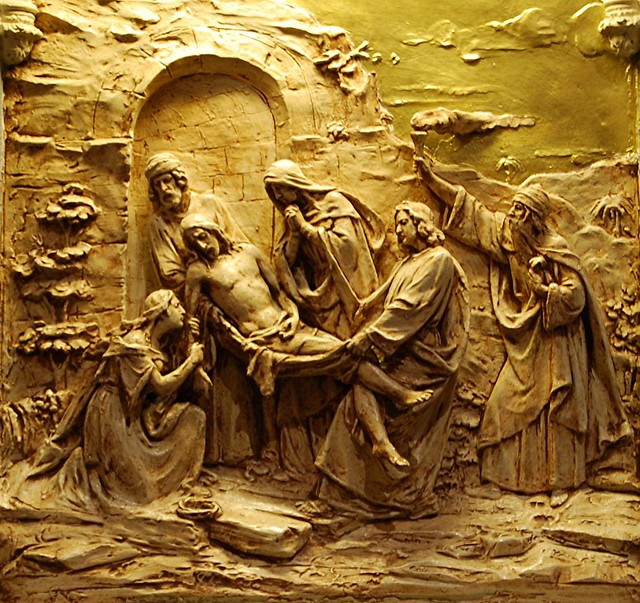
Jesus is laid in the tomb
The Way of the Cross with Pope Benedict XVI
V. We adore Thee, O Christ, and we bless Thee.
R. Because by Thy holy Cross Thou hast redeemed the world.
From the Gospel according to Matthew 27:59-61

Joseph took the body, and wrapped it in a clean linen shroud, and laid it in his own new tomb, which he had hewn in the rock; and he rolled a great stone to the door of the tomb, and departed. Mary Magdalene and the other Mary were there, sitting opposite the sepulcher.

MEDITATION

Jesus, disgraced and mistreated, is honorably buried in a new tomb. Nicodemus brings a mixture of myrrh and aloes, about a hundred pounds weight, which gives off a precious scent. In the Son's self-offering, as at his anointing in Bethany, we see an "excess" which evokes God's generous and superabundant love. God offers himself unstintingly. If God's measure is superabundance, then we for our part should consider nothing too much for God. This is the teaching of Jesus himself, in the Sermon on the Mount (Mt 5:20). But we should also remember the words of Saint Paul, who says that God "through us spreads the fragrance of the knowledge of Christ everywhere. We are the aroma of Christ" (2 Corinthians 2:14ff.). Amid the decay of ideologies, our faith needs once more to be the fragrance which returns us to the path of life. At the very moment of his burial, Jesus' words are fulfilled: "Truly, truly, I say to you, unless a grain of wheat falls to the earth and dies, it remains alone; but if it dies, it bears much fruit" (John 12:24). Jesus is the grain of wheat which dies. From that lifeless grain of wheat comes forth the great multiplication of bread which will endure until the end of the world. Jesus is the bread of life which can satisfy superabundantly the hunger of all humanity and provide its deepest nourishment. Through his Cross and Resurrection, the eternal Word of God became flesh and bread for us. The mystery of the Eucharist already shines forth in the burial of Jesus.

PRAYER

Lord Jesus Christ, in your burial you have taken on the death of the grain of wheat. You have become the lifeless grain of wheat which produces abundant fruit for every age and for all eternity. From the tomb shines forth in every generation the promise of the grain of wheat which gives rise to the true manna, the Bread of Life, in which you offer us your very self. The eternal Word, through his Incarnation and death, has become a Word which is close to us: you put yourself into our hands and into our hearts, so that your word can grow within us and bear fruit. Through the death of the grain of wheat you give us yourself, so that we too can dare to lose our life in order to find it, so that we too can trust the promise of the grain of wheat. Help us grow in love and veneration for your Eucharistic mystery -- to make you, the Bread of heaven, the source of our life. Help us to become your "fragrance," and to make known in this world the mysterious traces of your life. Like the grain of wheat which rises from the earth, putting forth its stalk and then its ear, you could not remain enclosed in the tomb: the tomb is empty because he -- the Father -- "did not abandon you to the nether world, nor let your flesh see corruption" (Acts 2:31; Ps 16:10 LXX). No, you did not see corruption. You have risen, and have made a place for our transfigured flesh in the very heart of God. Help us to rejoice in this hope and bring it joyfully to the world. Help us to become witnesses of your Resurrection.

All: OUR FATHER, who art in heaven, hallowed be Thy name. Thy kingdom come. Thy will be done on earth as it is in heaven. Give us this day our daily bread and forgive us our trespasses as we forgive those who trespass against us. And lead us not into temptation, but deliver us from evil. Amen.

By the Cross with thee to stay,
there with thee to weep and pray,
is all I ask of thee to give.

Previous Way of the Cross posts:

Way of the Cross - Station Thirteen

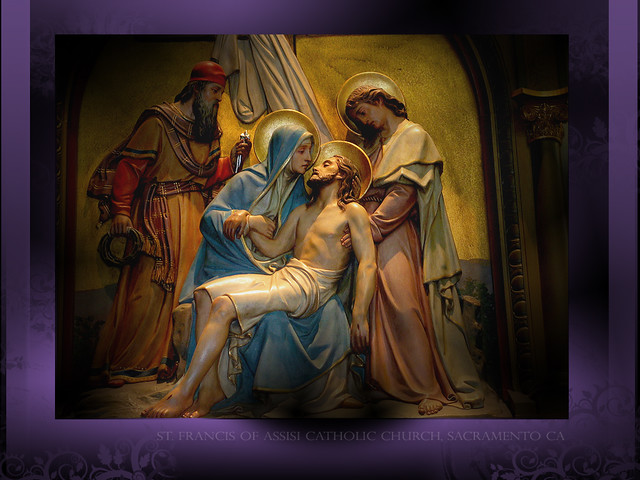
Jesus is taken down from the Cross and given to his Mother
The Way of the Cross with Pope Benedict XVI
V. We adore Thee, O Christ, and we bless Thee.
R. Because by Thy holy Cross Thou hast redeemed the world.
From the Gospel according to Matthew 27:54-55

When the centurion and those who were with him, keeping watch over Jesus, saw the earthquake and what took place, they were filled with awe, and said, "Truly this was the Son of God!" There were also many women there, looking on from afar, who had followed Jesus from Galilee, ministering to him.

MEDITATION

Jesus is dead. From his heart, pierced by the lance of the Roman soldier, flow blood and water: a mysterious image of the stream of the sacraments, Baptism and the Eucharist, by which the Church is constantly reborn from the opened heart of the Lord. Jesus' legs are not broken, like those of the two men crucified with him. He is thus revealed as the true Paschal lamb, not one of whose bones must be broken (…). And now, at the end of his sufferings, it is clear that, for all the dismay which filled men's hearts, for all the power of hatred and cowardice, he was never alone. There are faithful ones who remain with him. Under the Cross stands Mary, his Mother, the sister of his Mother, Mary, Mary Magdalen and the disciple whom he loved. A wealthy man, Joseph of Arimathea, appears on the scene: a rich man is able to pass through the eye of a needle, for God has given him the grace. He buries Jesus in his own empty tomb, in a garden. At Jesus' burial, the cemetery becomes a garden, the garden from which Adam was cast out when he abandoned the fullness of life, his Creator. The garden tomb symbolizes that the dominion of death is about to end. A member of the Sanhedrin also comes along, Nicodemus, to whom Jesus had proclaimed the mystery of rebirth by water and the Spirit. Even in the Sanhedrin, which decreed his death, there is a believer, someone who knows and recognizes Jesus after his death. In this hour of immense grief, of darkness and despair, the light of hope is mysteriously present. The hidden God continues to be the God of life, ever near. Even in the night of death, the Lord continues to be our Lord and Savior. The Church of Jesus Christ, his new family, begins to take shape.

PRAYER

Lord, you descended into the darkness of death. But your body is placed in good hands and wrapped in a white shroud (Matthew 27:59). Faith has not completely died; the sun has not completely set. How often does it appear that you are asleep? How easy it is for us to step back and say to ourselves: "God is dead." In the hour of darkness, help us to know that you are still there. Do not abandon us when we are tempted to lose heart. Help us not to leave you alone. Give us the fidelity to withstand moments of confusion and a love ready to embrace you in your utter helplessness, like your Mother, who once more holds you to her breast. Help us, the poor and rich, simple and learned, to look beyond all our fears and prejudices, and to offer you our abilities, our hearts and our time, and thus to prepare a garden for the Resurrection.

All: OUR FATHER, who art in heaven, hallowed be Thy name. Thy kingdom come. Thy will be done on earth as it is in heaven. Give us this day our daily bread and forgive us our trespasses as we forgive those who trespass against us. And lead us not into temptation, but deliver us from evil. Amen.

Let me mingle tears with thee,
mourning Him who mourned for me,
all the days that I may live

Previous Way of the Cross posts:

Way of the Cross - Station Twelve

Jesus dies on the Cross
The Way of the Cross with Pope Benedict XVI
V. We adore Thee, O Christ, and we bless Thee.
R. Because by Thy holy Cross Thou hast redeemed the world.
From the Gospel according to John 19:19-20

Pilate also wrote a title and put it on the Cross; it read, "Jesus of Nazareth, the King of the Jews." Many of the Jews read this title, for the place where Jesus was crucified was near the city; and it was written in Hebrew, in Latin, and in Greek.

From the Gospel according to Matthew 27:45-50,54

Now from the sixth hour there was darkness over all the land until the ninth hour. And about the ninth hour Jesus cried with a loud voice, "Eli, Eli, lama sabachthani?" That is, "My God, my God, why have you forsaken me?" And some of the bystanders hearing it said, "This man is calling Elijah." And one of them at once ran and took a sponge, filled it with vinegar, and put it on a reed, and gave it to him to drink. But the others said, "Wait, let us see whether Elijah will come to save him." And Jesus cried again with a loud voice and yielded up his spirit." When the centurion and those who were with him, keeping watch over Jesus, saw the earthquake and what took place, they were filled with awe, and said, "Truly this was the Son of God!"

MEDITATION

In Greek and Latin, the two international languages of the time, and in Hebrew, the language of the Chosen People, a sign stood above the Cross of Jesus, indicating who he was: the King of the Jews, the promised Son of David. Pilate, the unjust judge, became a prophet despite himself. The kingship of Jesus was proclaimed before the entire world. Jesus himself had not accepted the title "Messiah," because it would have suggested a mistaken, human idea of power and deliverance. Yet now the title can remain publicly displayed above the Crucified Christ. He is indeed the king of the world. Now he is truly "lifted up." In sinking to the depths he rose to the heights. Now he has radically fulfilled the commandment of love, he has completed the offering of himself, and in this way he is now the revelation of the true God, the God who is love. Now we know who God is. Now we know what true kingship is. Jesus prays Psalm 22, which begins with the words: "My God, my God, why have you forsaken me?" (Psalm 22:2). He takes to himself the whole suffering people of Israel, all of suffering humanity, the drama of God's darkness, and he makes God present in the very place where he seems definitively vanquished and absent. The Cross of Jesus is a cosmic event. The world is darkened, when the Son of God is given up to death. The earth trembles. And on the Cross, the Church of the Gentiles is born. The Roman centurion understands this, and acknowledges Jesus as the Son of God. From the Cross he triumphs -- ever anew.

PRAYER

Lord Jesus Christ, at the hour of your death the sun was darkened. Ever anew you are being nailed to the Cross. At this present hour of history we are living in God's darkness. Through your great sufferings and the wickedness of men, the face of God, your face, seems obscured, unrecognizable. And yet, on the Cross, you have revealed yourself. Precisely by being the one who suffers and loves, you are exalted. From the Cross on high you have triumphed. Help us to recognize your face at this hour of darkness and tribulation. Help us to believe in you and to follow you in our hour of darkness and need. Show yourself once more to the world at this hour. Reveal to us your salvation.

All: OUR FATHER, who art in heaven, hallowed be Thy name. Thy kingdom come. Thy will be done on earth as it is in heaven. Give us this day our daily bread and forgive us our trespasses as we forgive those who trespass against us. And lead us not into temptation, but deliver us from evil. Amen.

Let me share with thee His pain,
who for all my sins was slain,
who for me in torments died.

Previous Way of the Cross posts:

Way of the Cross - Station Eleven

Jesus is nailed to the Cross
The Way of the Cross with Pope Benedict XVI
V. We adore Thee, O Christ, and we bless Thee.
R. Because by Thy holy Cross Thou hast redeemed the world.
From the Gospel according to Matthew 27:37-42

And over his head they put the charge against him, which read, "This is Jesus the King of the Jews." Then two robbers were crucified with him, one on the right hand and one on the left. And those who passed by derided him, wagging their heads and saying, "You who would destroy the temple and build it in three days, save yourself! If you are the Son of God, come down from the Cross." So also the chief priests with the scribes and elders mocked him, saying, "He saved others; he cannot save himself. He is the King of Israel; let him come down now from the Cross and we will believe in him."

MEDITATION

Jesus is nailed to the Cross. The shroud of Turin gives us an idea of the unbelievable cruelty of this procedure. Jesus does not drink the numbing gall offered to him: he deliberately takes upon himself all the pain of the Crucifixion. His whole body is racked; the words of the Psalm have come to pass: "But I am a worm and no man, scorned by men, rejected by the people" (Psalm 22:7). "As one from whom men hide their faces, he was despised ... surely he has borne our griefs and carried our sorrows" (Isaiah 53:3f.). Let us halt before this image of pain, before the suffering Son of God. Let us look upon him at times of presumptuousness and pleasure, in order to learn to respect limits and to see the superficiality of all merely material goods. Let us look upon him at times of trial and tribulation, and realize that it is then that we are closest to God. Let us try to see his face in the people we might look down upon. As we stand before the condemned Lord, who did not use his power to come down from the Cross, but endured its suffering to the end, another thought comes to mind. Ignatius of Antioch, a prisoner in chains for his faith in the Lord, praised the Christians of Smyrna for their invincible faith: he says that they were, so to speak, nailed with flesh and blood to the Cross of the Lord Jesus Christ (1:1). Let us nail ourselves to him, resisting the temptation to stand apart, or to join others in mocking him.

PRAYER

Lord Jesus Christ, you let yourself be nailed to the Cross, accepting the terrible cruelty of this suffering, the destruction of your body and your dignity. You allowed yourself to be nailed fast; you did not try to escape or to lessen your suffering. May we never flee from what we are called to do. Help us to remain faithful to you. Help us to unmask the false freedom which would distance us from you. Help us to accept your "binding" freedom, and, "bound" fast to you, to discover true freedom.

All: OUR FATHER, who art in heaven, hallowed be Thy name. Thy kingdom come. Thy will be done on earth as it is in heaven. Give us this day our daily bread and forgive us our trespasses as we forgive those who trespass against us. And lead us not into temptation, but deliver us from evil. Amen.

Holy Mother! pierce me through,
in my heart each wound renew