Sunday, July 29, 2012
The Joy of Being Wrong & The Violence of Our Knowledge Assumes a Trajectory and Target
Letting 2 videos speak to learning - a movement from violence to becoming something more.

Friday, July 27, 2012
John Halton post: My parents, my siblings
Confessing Evangelical
This is a re-posting from John Halton
Friday 26th March, AD 2010
Man hands on misery to man.
It deepens like a coastal shelf.
Get out as early as you can,
And don’t have any kids yourself.- Philip Larkin, This Be The Verse
And call no one your father on earth, for you have one Father – the one in heaven.
What does Jesus mean when he tells us to “call no one your father on earth”? James Alison tackles this question as part of a fascinating essay on John 8:31-59, “Jesus’ fraternal relocation of God” (from his book Faith Beyond Resentment).
Jesus’ debate with the Pharisees in John 8 revolves in large measure around claims of paternity: the Pharisees’ claim to be children of Abraham, versus Jesus’ assertion that:
You are from your father the devil, and you choose to do your father’s desires. He was a murderer from the beginning and does not stand in the truth, because there is no truth in him. (John 8:44)
Dr Alison argues that Jesus is not engaging in a tit-for-tat trading of insults with the Pharisees, but making a profound statement about the nature of human society: namely, that it is founded on fratricidal murder, going back to the time of Cain’s murder of Abel (note this point remains valid even if you prefer to see the account of Cain and Abel as myth, because the message of it as myth is precisely that human culture has its roots in fratricide). Hence:
any earthly paternity [whether cultural or biological] is ultimately a reflection of the murderous distortion of fraternity into fratricide.
Protestants are fond of throwing Jesus’ words in Matthew 23:9 back at Roman Catholics, and Alison acknowledges the “wry irony” of calling priests “father” and the pope “Holy Father”. However, Jesus does not restrict his injunction to calling religious leaders “father”:
Much more strikingly, he forbids us from calling anyone “father”. And the most evident meaning of this is: especially our progenitors. (p.75)
Alison observes that even the most ardent opponent of calling priests “father” is unlikely to ditch the normal, familial use of the word. Jesus wasn’t aiming for “the grammatical feat of eliminating a common word from everyday use”. Rather, his aim was:
…making quite sure that we learn not to attribute anything sacred to our progenitors, whether cultural or biological, as progenitors.
The point is that we tend to see anything we have inherited from our progenitors (whether parental, cultural, national or religious) as in some sense sacred, unchallengeable – even if we are in rebellion against it (Alison describes this as having been his experience as a gay Catholic). Whereas any human so-called paternity is really just a mask for the sibling-slaying that has always characterised human society: “call no one your father on earth”.
So, where does all this take us? Simply this: that Jesus is calling us to treat our parents (and indeed all our “progenitors”) as our siblings. We can see this in his treatment of his own mother in Mark 3:31-35 (another text which Protestants are fond of throwing at Catholics). It is not that Jesus is belittling or downplaying his mother. However:
Jesus explicitly saw his female progenitor, the guardian of his infancy and childhood, as, in the first place, his sister, and only as his “mother” in an analogous sense that he was perfectly happy for others to occupy as well. (p.78)
So also for us:
We have to learn step by arduous step how to think and act free of our “paternal” group belonging and instead to live and act as ones who only have siblings, including intergenerational ones who need fraternal treatment appropriate to their age and strength. (p.78)
This in turn leads us to see our parents’ faults and errors (or those of our cultural progenitors) not as existing in some category on their own, but as part of a wider pattern of damaged sibling relationships, a pattern in which both we and they are equally caught up. And this then provides a gateway for forgiveness, because forgiving someone involves “becoming aware of them as people on the same level as yourself”. In contrast:
As sons and daughters we can never forgive paternal and maternal damage held to have formed us, because as sons and daughters we can never be on the same level as the “paternal” or “maternal”. (p.79)
We can either see the damage done by our biological (or cultural, national, religious) progenitors as a fundamental aspect of those relationships, “which means we stay at the level of resentful recipients”. Or:
we can begin to realise that the distorted paternity and maternity we received are simply particular instances of the fratricidal nature of human culture. (p.79)
In other words, the things that (in Larkin’s words) “f–k you up” are not “our progenitors as progenitors or our offspring as offspring“. Rather it is “as brothers and sisters” that the damage is both done and overcome.
The damage is done so long as our siblinghood is modelled on that of Cain and Abel: whether we see ourselves as “‘victims’ of the ‘dead hand of the past’”, claiming the mantle of Abel, or as “nobly regretful ‘champions’ of unalterable divine traditions”, claiming the mantle of cultural paternity which Jesus exposes as a mask for the sibling-slaying violence of Cain.
It is overcome as we come to realise that “the Creator of the universe has spoken to us definitively as brother”: Jesus, who speaks to us “entirely at the fraternal level, unbinding our sibling rivalry and fratricide”, and thus leading us to “know ourselves loved as children of a non-rivalrous Parent” – God the Father, whom Jesus identifies as the only source of true paternity (“you have one Father – the one in heaven”).
Monday, July 23, 2012
The line between Good and Evil cuts through the heart

From The Gulag Archipelago by Aleksandr Solzhenitsyn
If only there were evil people somewhere insidiously committing evil deeds, and it were necessary only to separate them from the rest of us and destroy them. But the line dividing good and evil cuts through the heart of every human being. And who is willing to destroy a piece of his own heart?During the life of any heart this line keeps changing place; sometimes it is squeezed one way by exuberant evil and sometimes it shifts to allow enough space for good to flourish. One and the same human being is, at various ages, under various circumstances, a totally different human being. At times he is close to being a devil, at times to sainthood. But his name doesn’t change, and to that name we ascribe the whole lot, good and evil.Socrates taught us: “Know thyself.”
Confronted by the pit into which we are about to toss those who have done us harm, we halt, stricken dumb: it is after all only because of the way things worked out that they were the executioners and we weren’t.
Friday, July 13, 2012
Tom Cruise remembered at reunion of seminarians

Exclusive: Tom Cruise's Year at the Seminary
Before Tom Cruise was a Scientologist, he was as devout a Roman Catholic as was his now estranged wife, Katie Holmes.
And just in time for Cruise’s 50th birthday and just as his
third marriage was unraveling, the priest who recruited him for the seminary
more than three decades ago mailed him a photo.
 |
| Courtesy of Father Ric Schneider |
“I found an address online in Los Angeles
Not that Father Ric was sending Cruise a message. The priest
just thought the star might enjoy this captured memory of him in earth shoes
and an unbuttoned shirt, standing beside another boy by a pond. A smiling
Cruise is holding a radio-controlled boat the boys built in the hobby shop at
St. Francis Seminary just outside Cincinnati in Mt. Healthy , Ohio
“A cute
little kid,” Father Ric says... Link to the rest of the story HERE
We love God only with mediocre love...
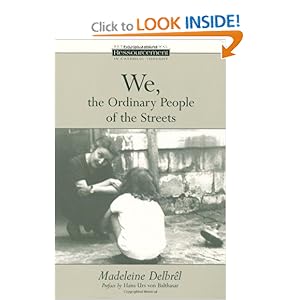 |
We, the Ordinary People of the Streets |
For the faith that we have received from Jesus Christ enables us to love God because it enables us to know him. But because we often tend to live our Christianity like a habit, we do not make use of this ability, or at least we do not make sufficient use of it. We love God only with a mediocre love because our knowledge of him is mediocre. Now, it would therefore follow that the first of our tasks in time is to know God as much as possible, in order to glorify him as much as possible and to compensate as much as possible for our neighbor's lack of knowledge of him.
If we are fully convinced of this first temporal duty, I think we will be able to confront all the rest of our temporal duties without unbalancing our supernatural life: for these duties carry us implacably deeper into the first and second commandments that the Lord gave us.
Servant of God Madeleine Delbrêl
Madeleine Delbrêl (+1964) was a French laywoman, writer, and mystic devoted to caring for the poor and to evangelizing culture.
From Magnificat
Friday, July 6, 2012
Dawn Eden on St Maximilian and Marian Devotion
No sound bite here but well worth the listen!
Dawn Eden the author of "The Thrill of The Chaste" gives a spur of the moment interview with the Franciscans of the Immaculate, at the Marian Friary "Our Lady of Guadalupe" in Griswold Connecticut.
PART 1
PART 2
PART 3
Reading Catholic: After the Revolution, Rotten Fruit, Discouragement--And Hope: July 2012 Column
Reading Catholic: After the Revolution, Rotten Fruit, Discouragement--And Hope: July 2012 Column
It is hard to read (or listen to) what is often the most important words... say... the Passion narrative. Nancy Piccione reflects on 2 books in this review and I can wholeheartedly vouch for Ms Eden as an author and person. Humbly I go down on my knees and ask for forgiveness as I too "was especially drawn to various trendy, or what we called back in the day “politically correct,” ideas and philosophies." Thank you Nancy for this review.
It is hard to read (or listen to) what is often the most important words... say... the Passion narrative. Nancy Piccione reflects on 2 books in this review and I can wholeheartedly vouch for Ms Eden as an author and person. Humbly I go down on my knees and ask for forgiveness as I too "was especially drawn to various trendy, or what we called back in the day “politically correct,” ideas and philosophies." Thank you Nancy for this review.
Here is clip from Dawn Eden on her new book and a special invitation to all. Check it out.
Subscribe to:
Posts (Atom)